Alerts you can explain, months after you raised them.
Monitor
The spreadsheet problem
Most small licensees monitor transactions in Excel. It works, until an inspector asks why a particular transaction was reviewed in March and a similar one was not — and the answer lives in a workbook that has been edited two hundred times since, by people who have moved on.
The difficulty is rarely finding suspicious activity. It is proving, later, what you looked for, what you found, and why you decided what you decided.
What Monitor does
Twenty detection rules run on a frozen, deterministic engine. Each rule carries a definition version, and that version is written onto every alert it raises — so an alert stays attributable to the rule exactly as it read on the day, even after the rule changes.
Opening an alert shows the rule, the parameters that were in force, the period reviewed, every figure the rule measured, and the transactions it matched. There is no score to take on trust.
Rules run in shadow until a compliance sign-off is recorded, and the sign-off snapshots the parameters that will actually run rather than the library defaults. You can read what a rule would have raised before you let it raise anything.
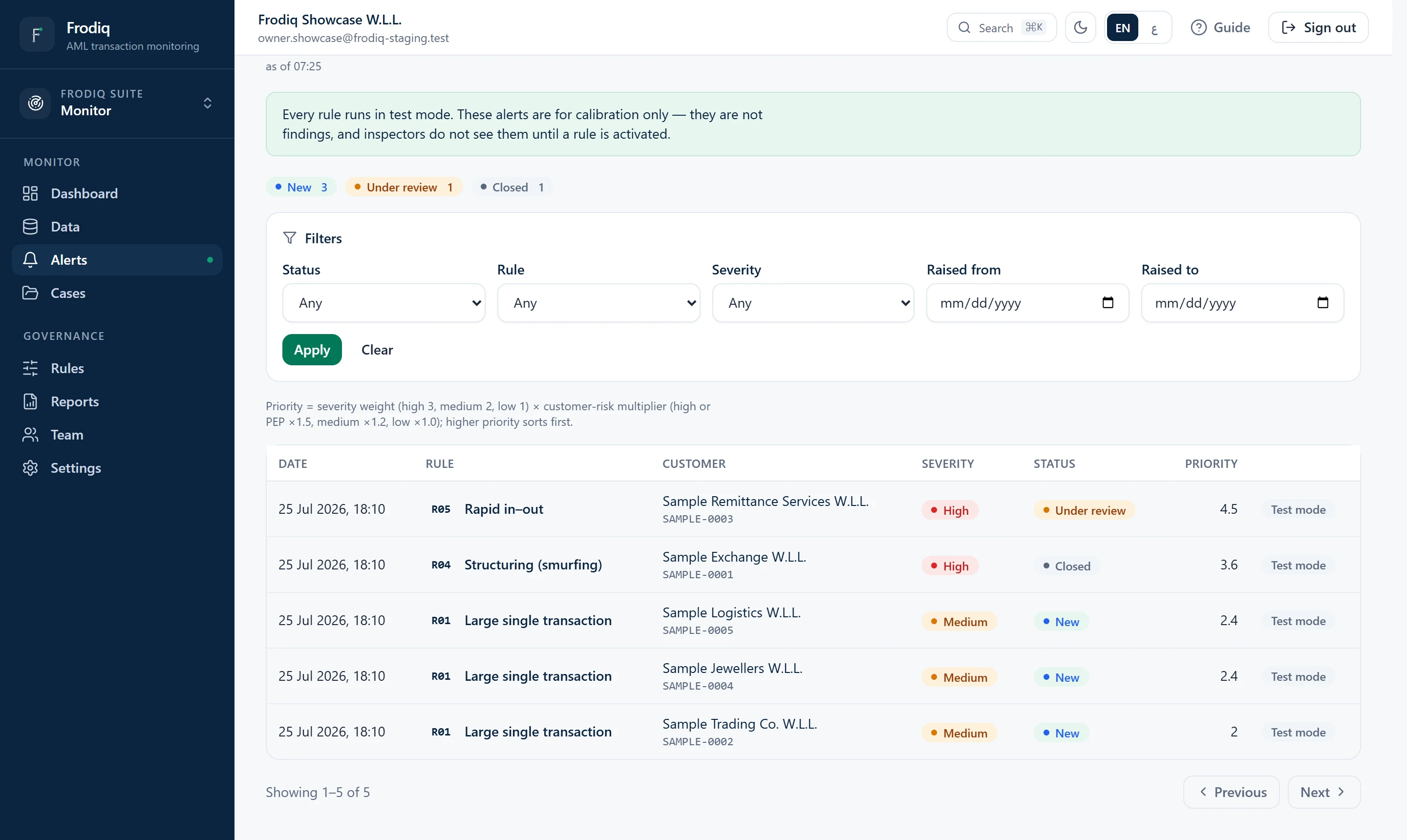
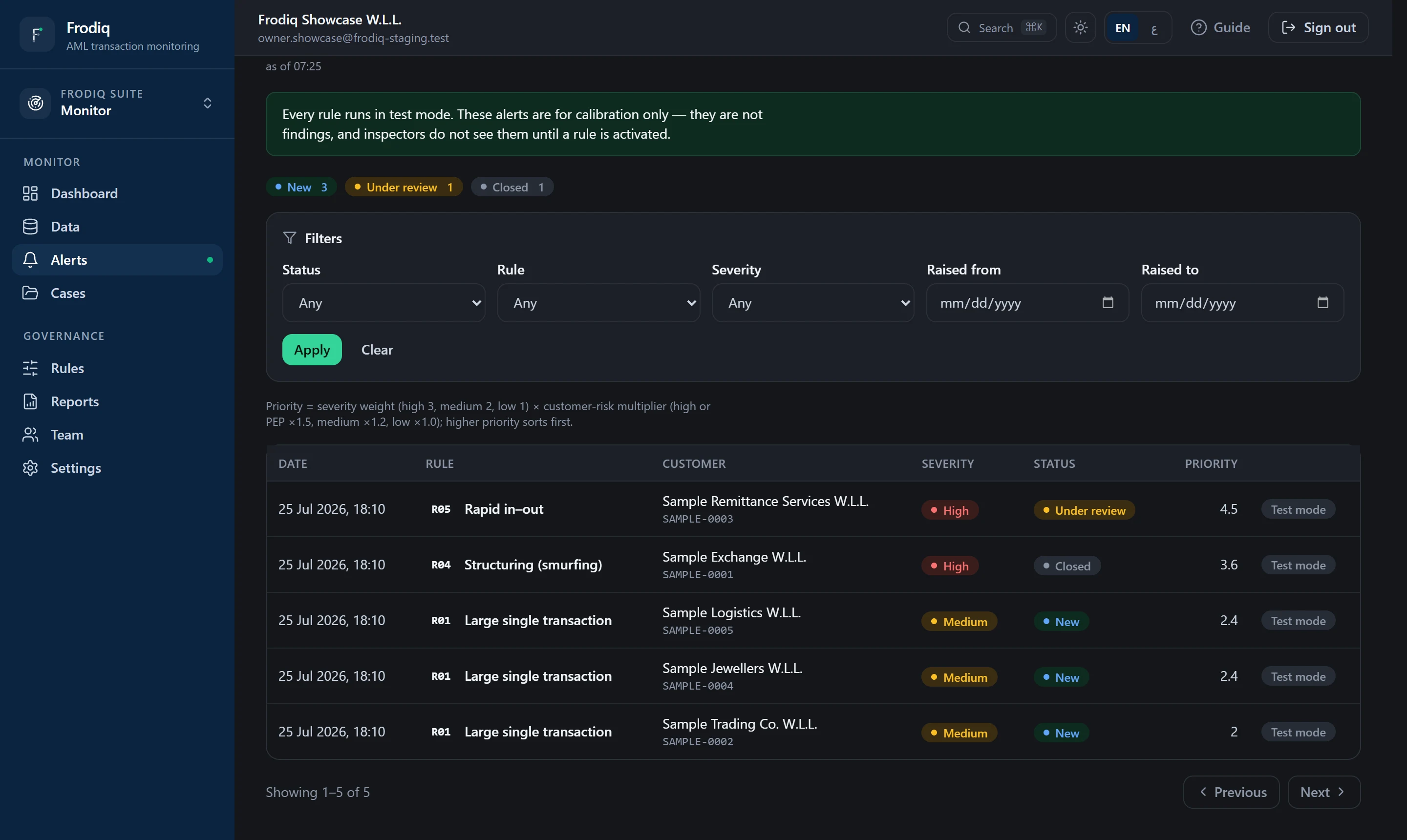
Synthetic data
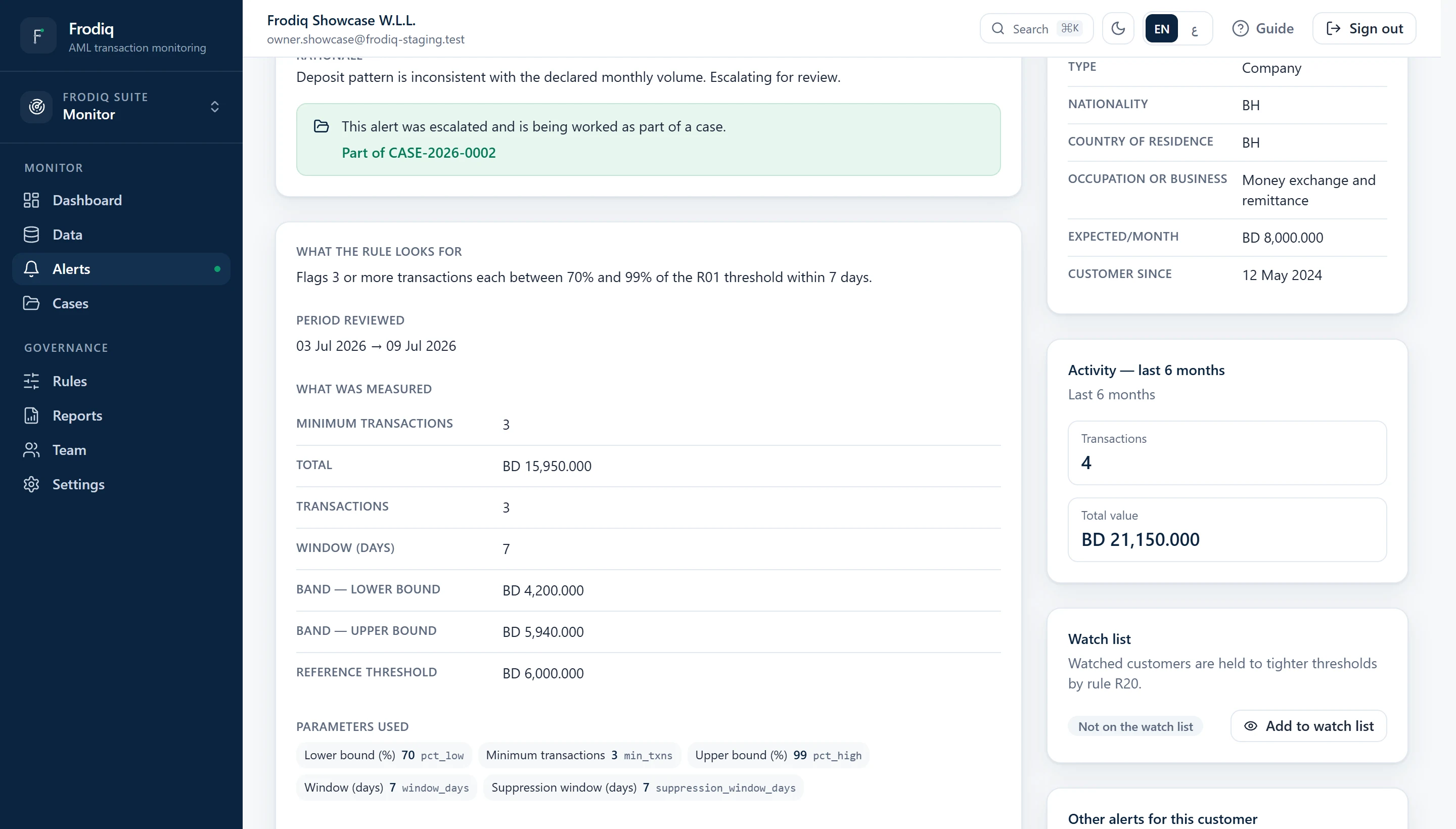
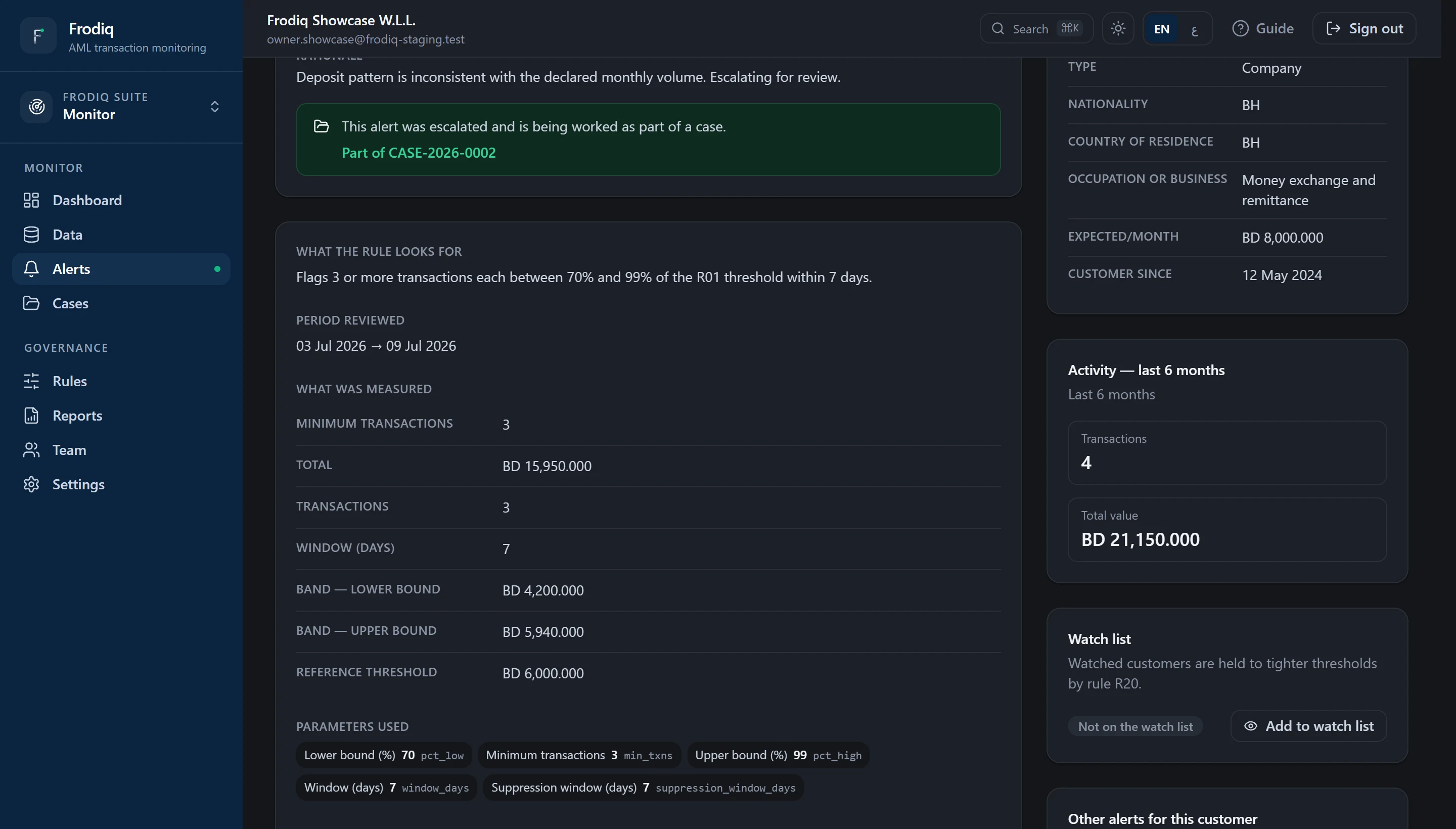
Synthetic data
What the record keeps
Each of these is enforced by the database rather than by a convention.
- The reasoning is stored on the alert, not reconstructed later
Every alert carries the rule it came from, the version of that rule, the parameters in force when it ran, and the transactions that triggered it. A reviewer opens evidence, not a score.
- The same inputs raise the same alerts, every time
The engine is a frozen path: no sampling, no model drift, no ordering that changes between runs. Re-run last quarter and you get last quarter's alerts — which is what makes an alert something you can defend rather than something you have to explain.
- Nothing goes live without a recorded sign-off
A rule cannot reach the live state until an accepted compliance sign-off exists, and the sign-off snapshots the parameters that will actually run — not the library's defaults. Until then it runs in shadow, where you can read what it would have raised.
- 20 versioned detection rules
Each rule carries a definition version that is snapshotted onto every alert it raises, so an alert stays attributable to the rule as it read that day.
See it on your own rules.
A walkthrough on your book and your thresholds, not a canned demo.
Sunday to Thursday, 9am to 5pm Bahrain time. WhatsApp is usually fastest; email reaches us either way.
Call: +973 3617 8912
Invoiced by bank transfer. Prices exclude applicable VAT.